
The Sameness of AI
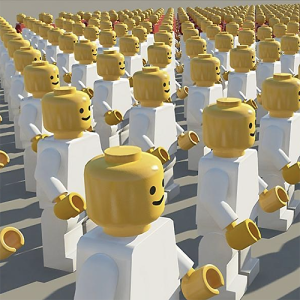
When my nephew was about six years old, I had his future figured out. He was great at math and could build just about anything with Legos. So, naturally, I decided he should go to MIT and become an engineer.
The equation in my head was simple:
Good at math + LEGO = MIT
MIT + engineering = secure future
It seemed perfectly logical. He had the kinds of abilities we have traditionally associated with career success: analytical, technical, good at figuring out how things worked. If you had asked me then whether being exceptionally good at engineering or exceptionally good with people offered the better path to career success, I would have picked engineering without hesitation.
He’s 22 now, and it turns out I may have identified the wrong superpower.
He’s still good at math (I haven’t seen the LEGOs in many years), but his real gift is people. He is quite fearless in interpersonal situations and can talk to anyone. More importantly, he listens well and remembers things people tell him. He’s genuinely interested in other people and comfortable walking into interpersonal work situations that would make many of us nervous.
Today, he’s working in a sales-type role where he interacts with people all day. He loves it, he’s good at it and he’s eager to learn more. And, of course, he uses AI in his job.
AI can help him research a prospect, organize information, prepare for a meeting, suggest questions and draft a follow-up email. Then he has to talk to the person. And that’s where a different kind of ability takes over.
Considering I’ve spent my career helping people develop the human capabilities required to work effectively with other people, I should have known this from the start. Apparently, even someone who has spent her career teaching human skills can be seduced by math and LEGO.
AI Is Commoditizing Competence
For most of our careers, information itself was an advantage. If you knew something your competitor didn’t know, had access to research someone else hadn’t seen or possessed expertise that took years to acquire, you had an edge.
AI is changing that equation very quickly. A college intern and a 30-year veteran can now open the same AI tool and ask it the same question. A solo consultant and someone working for a huge corporation may have access to the same underlying models.
That doesn’t mean they’ll get identical results. Some people are considerably better at using AI than others. One of the things I work on with clients is problem framing: understanding the actual problem before prompting, being specific about what a good outcome looks like and providing AI with the context it doesn’t have.
Two capable people using comparable AI tools, working with similar information and trying to solve the same problem now have access to an extraordinary amount of the same intellectual horsepower. Both can research a market, generate ideas, analyze information, draft a proposal, write an email, create a presentation and prepare talking points.
That’s remarkable. But it also means simply being able to produce those things is becoming less remarkable. AI has made “pretty good” pretty easy to produce.
And when everyone can be competent, competence stops being the differentiator.
We Can Already Smell the Sameness
Sameness has a smell, and we’re getting very good at recognizing it.
It’s the email that sounds like every other AI-generated email. The LinkedIn post with the dramatic opening, the em dashes and the perfectly organized three-part lesson. The proposal that checks every box but somehow could have been written for almost any company. There may be absolutely nothing wrong with it. It’s competent, polished, reasonable and completely forgettable.
So, if everyone can produce a polished email or competent presentation, what makes people pay attention to yours? If everyone can walk into a meeting with an AI-assisted analysis, what makes people trust your recommendation?
That’s the part of the AI conversation that interests me most. The question isn’t how I differentiate myself from AI. It’s how I differentiate myself from everyone else who has AI.
If we all have access to increasingly sophisticated information, analysis, ideas and language, then the advantage must come from somewhere else.
I think it increasingly comes from us.
Maybe We Have “Future-Proof” Backwards
I was recently talking to a 26-year-old who was buying furniture for his new apartment. He was looking at couches from two different online vendors and had the same question for both. One company gave him an AI chatbot. At the other company, a real person picked up the phone.
He bought the couch from the company where the person answered.
What struck me was that he made a point of telling me how much he disliked dealing with AI chatbots. This wasn’t someone who was uncomfortable with technology. He’s 26 and uses it constantly. But when he was about to spend real money and had a question, he wanted to talk to a human being.
We’ve tended to assume that people doing relatively routine work like answering phones, helping customers and responding to questions are among those most vulnerable to automation because some, maybe all, of their tasks certainly will be automated. But perhaps we’re looking at vulnerability too narrowly.
What about the highly educated employee who is exceptionally good at crunching numbers but has never developed the ability to explain what the numbers mean, influence a decision, manage a relationship, exercise judgment or gain someone’s trust?
AI can crunch numbers extraordinarily well. It can analyze them, summarize them, identify patterns and turn them into respectable presentations. Meanwhile, the person who picks up the phone and makes a customer feel heard may be doing something considerably harder to replicate than we assumed.
The two furniture companies weren’t differentiated by access to information. Presumably, both could answer the question. They were differentiated by the interaction surrounding that information.
For the 20-something buying the couch, that human interaction had economic value. It resulted in a sale.
Perhaps the capabilities we once dismissed as “soft” aren’t sitting on the periphery of future employability. Perhaps they’re moving toward the center.
The Skills We Called “Soft” Are Becoming the Hard Differentiator
There is nothing soft about having a difficult conversation, holding someone accountable, influencing a skeptical stakeholder, managing conflict, giving honest feedback or standing in front of a room and changing someone’s mind.
Those things are hard to do, and AI may be making them more valuable precisely because they are harder to standardize.
AI can help us prepare for these situations. It can suggest how to respond to an unhappy client or help a manager organize her thoughts before giving feedback. What it can’t provide is the relationship surrounding those words: the trust built over time, the ability to read another person’s reaction, the judgment to change direction when the conversation isn’t going as expected or the credibility that makes someone listen to you in the first place.
These are the soft yet durable skills: communication, trust, accountability, conflict management, influence, listening, adaptability and judgment. Unlike access to information or a well-written first draft, they don’t suddenly become universally available because everyone gets access to a better model.
Great Words Still Need a Human Being
One of the things AI does exceptionally well is give us words when we don’t have them. It can help a manager prepare for a difficult feedback conversation, turn a jumble of thoughts into useful language for an employee evaluation, draft a thoughtful email or suggest how to explain a complicated decision.
I’m sure some of you are saying, “GREAT! I love the idea of having the perfect words provided to me.” I do, too. There is no virtue in struggling for 45 minutes to write an email that AI can help you write in five.
But the words alone don’t produce the outcome.
A beautifully written employee evaluation doesn’t make someone a good manager. The manager still must sit down with the employee, deliver the feedback, listen to the response and recognize when something isn’t landing. A perfectly drafted client email may help open a conversation, but it doesn’t build the relationship that makes the client trust you.
That distinction matters because work is still fundamentally social. Gallup has found that strong relationships at work are associated with measurable business outcomes, including customer engagement and profitability. More recent Microsoft research involving more than 1,500 U.S. knowledge workers who regularly use AI found that job satisfaction and intention to stay were much more closely tied to social connection with colleagues than to the AI-related factors researchers examined.
This isn’t a reason to use AI less. It’s a reason to use it for what it does extraordinarily well while preserving our time and attention for what people do extraordinarily well.
Let AI help you find the words, then have the conversation. Let it organize the employee evaluation, then sit across from the employee and talk about performance and development. Let it analyze the data, then use your experience and judgment to decide what the data means. Let it help prepare you for the sales call, then put the script aside and listen to the customer.
If AI saves me 40 minutes staring at a blank screen trying to construct the perfect email, that’s 40 minutes I can use for work that requires more of me. The value isn’t in proving I can write the email without AI. It’s in knowing what should, and shouldn’t, be delegated to it.
As AI gets better at supplying information, analysis and language, our responsibility increasingly shifts toward understanding context, exercising judgment and dealing effectively with other people. AI can give us an excellent starting point. A human being still must decide what makes sense in this situation, make the call and own what happens next.
The Competitive Advantage Is Moving
This brings me back to where I started. When my nephew was six, I saw math, LEGO and technical aptitude and I thought: engineer. I assumed those were the capabilities most likely to provide a secure future.
I wouldn’t make that assumption today.
It’s not because technical expertise has become less valuable. We need engineers, scientists, analysts and people with deep technical knowledge. AI fluency matters, too. But as more people gain access to the same extraordinary technology, neither access nor competence alone will differentiate us the way they once did.
The advantage begins moving toward the things that aren’t the same: the leader people trust, the colleague who does what she said she would do, the employee who can disagree constructively, the salesperson who actually listens, the manager who notices what isn’t being said and the professional who knows when a technically sound recommendation is completely wrong for the situation.
My nephew’s technical abilities haven’t disappeared. But the quality I underestimated when he was six may turn out to be one of his greatest professional assets: he is exceptionally good at dealing with human beings.
For years, we called many of these capabilities “soft skills” and treated them as secondary to technical expertise. AI is forcing us to reconsider that hierarchy. When information, ideas, analysis and competent content become available to almost everyone, those things inevitably become less effective as differentiators.
Human capabilities are different. You can’t download trust. You can’t prompt your way into credibility. AI can’t give you a reputation for keeping your word, make you genuinely curious about another person or give you the judgment that comes from years of experience dealing with people and situations that don’t fit neatly into a prompt.
Perhaps that’s the opportunity hidden inside the sameness. The question isn’t whether human beings can compete with AI. We don’t need to. The question is what will differentiate one person, one leader or one organization from another when all of them have AI.
Increasingly, I think the answer will be the qualities we once called “soft.”
AI may be creating more sameness in what we can produce. That means the things that make us distinctly human may become the most valuable differentiators we have.
